
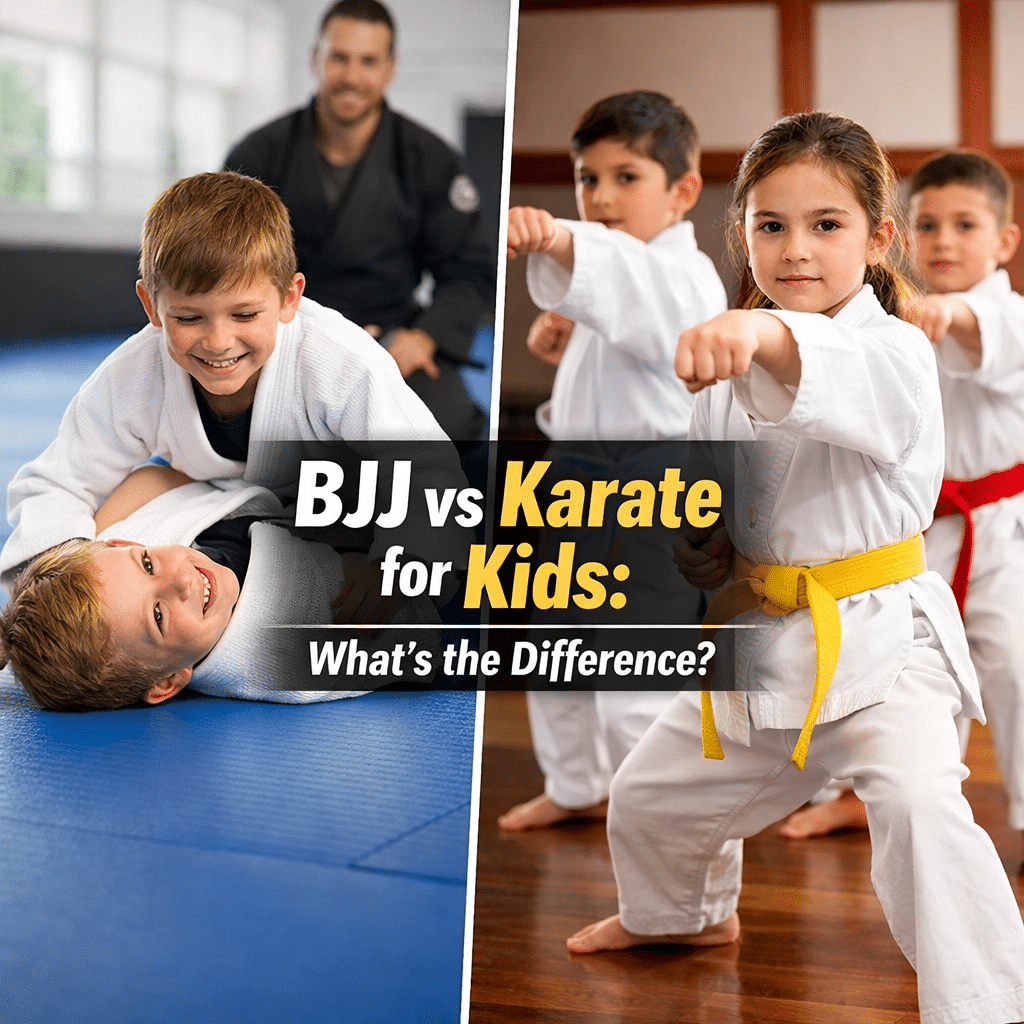
If you’re searching for the right martial art for your child, you’ve probably already Googled “karate near me” at least once. Karate is the default — it’s what most of us grew up seeing in movies, it’s in every strip mall, and it’s the name every parent recognizes. But more and more families in Medina, Plymouth, Maple Grove, and Wayzata are discovering that Brazilian Jiu-Jitsu (BJJ) offers something different — and for a lot of kids, something better. This page is our honest take on both. We’re a BJJ gym, so yes, we have a perspective. But we’ve also seen enough kids walk through our doors to know that the right art depends on the right child. Let’s break it down.
What Is Karate, Really?
Karate is a striking-based martial art that originated in Japan and Okinawa. It’s built around punches, kicks, blocks, and structured forms called kata. In a typical kids karate class, your child will practice techniques in lines, learn patterns of movement, progress through a color belt system, and develop discipline through repetition and structure.
There is genuine value in this. Karate teaches respect, focus, and physical coordination. The belt progression gives kids a clear sense of achievement, and the structured environment suits certain temperaments beautifully. We’re not here to knock it.
But there’s something important most karate parents don’t know until it’s too late: the majority of karate training happens in the air. Techniques are practiced against imaginary opponents, not resisting ones. A child can earn a black belt without ever testing their skills against someone who is actually trying to stop them.
What Is BJJ, and Why Is It Different?
Brazilian Jiu-Jitsu is a ground-based grappling art. Instead of punching and kicking, kids learn how to take someone down, control them on the ground, and apply submissions — joint locks and chokes — to end a confrontation safely. More importantly, every single class involves live sparring against a real, resisting partner.
That last part is what changes everything.
When your child rolls (that’s what we call sparring in BJJ), they’re not practicing against air. They’re up against someone who is genuinely trying to pin them, sweep them, or submit them. And your child has to figure out — in real time, under real pressure — how to respond. That process of failing, problem-solving, and trying again is the engine behind everything parents love about BJJ: the confidence, the resilience, the focus.
The 5 Biggest Differences Between BJJ and Karate for Kids
1. Live Sparring vs. Practiced Forms
In BJJ, kids spar from their very first few weeks. In many karate programs, sparring is limited, controlled, or optional entirely. The difference matters because real confidence comes from being genuinely tested — not from practicing a kick into empty air a thousand times.
2. Technique Over Size
BJJ was specifically designed so that a smaller, weaker person can control and submit a larger, stronger one using leverage and positioning. This is why it’s become the foundation of modern self-defense — and why it’s especially empowering for kids who aren’t the biggest in the room. A child who trains BJJ for six months has tools that work regardless of the size of the person they’re dealing with.
3. Real-World Self-Defense
Most real-world confrontations — whether between kids on a playground or adults in a parking lot — end up on the ground. Karate, focused on striking, leaves a practitioner without tools the moment a situation goes to the ground. BJJ is built for exactly that scenario. Your child learns to protect themselves in the position where most real situations end up.
4. Safety
Because BJJ doesn’t involve punching or kicking, the injury risk for young practitioners is lower than many striking arts. Students tap out when they’re in a submission they can’t escape — which means they can train hard without getting hurt. We’ve trained kids as young as 4 at Atheneum, and safety is always our first priority on the mats.
5. The Mental Game
BJJ is regularly called “human chess.” Every roll is a problem to be solved in real time — where do I put my hips? How do I create space? What happens if I try this sweep? Kids who train BJJ develop a genuinely different kind of focus and strategic thinking than kids in most other sports or activities. Parents notice it first — their kid gets quieter, more observant, quicker to think before reacting.
So When Is Karate the Right Choice?
We promised honest, so here it is: karate may be a better fit if your child is drawn to tradition, ceremony, and structure. If they love the idea of kata, of a highly organized curriculum, of the aesthetic and culture of Japanese martial arts — karate is genuinely great for that. Some kids thrive in that world.
It’s also worth noting that some children simply aren’t comfortable with the physical contact that BJJ requires. Grappling involves being close to another person, being held down, and working out of uncomfortable positions. For most kids this becomes one of their favorite parts of training within a few weeks. But if your child is particularly averse to contact, that’s worth considering.
What Parents in Plymouth, Maple Grove & Wayzata Are Telling Us
We serve families from all across the west metro — Medina, Plymouth, Maple Grove, Wayzata, and beyond. Here’s what we hear most often from parents who made the switch from karate to BJJ:
“I was skeptical at first — BJJ sounded intense for a 7-year-old. But within a month he was more confident at school, more patient at home, and genuinely excited to go to class every week.”
“My daughter had done karate for two years. She was good at the forms but she told me it felt fake. After one class at Atheneum she didn’t want to leave.”
“We live in Plymouth and drive out to Medina because we haven’t found anything like this closer to home. The community here is different.”
Why Atheneum Martial Arts Is Different From Other Gyms Near Plymouth and Maple Grove
There are other BJJ gyms in the area. Here’s what makes Atheneum different:
We are a full martial arts gym, not just a BJJ academy. Beyond BJJ, we offer Muay Thai, MMA, and more — which means as your child grows and their interests evolve, we can grow with them. They don’t need to leave and find a new gym when they want to try striking.
Everyone knows your name here. We’re a smaller, community-first gym by design. Our coaches know every kid, every parent, and every student’s goals. You are not a number. The reviews from our families speak for this better than we can.
We serve all levels and all ages. Our kids program runs separate age-grouped classes for younger kids (ages 5–7) and older kids (ages 8–12), so your child is always training with kids at a similar developmental stage.
The first class is always free. We don’t believe in pressuring families into memberships. Come in, watch a class, let your child try it, and see how they feel. That’s the only way to really know.
Frequently Asked Questions
What age can my child start BJJ?
At Atheneum we welcome kids as young as 5. Our youngest class (ages 5–7) is specifically designed for early learners — focused on movement, body awareness, and fun before we layer in technique.
Is BJJ safe for kids?
Yes — BJJ is widely considered one of the safest martial arts for children precisely because it doesn’t involve striking. Students learn to tap out when they’re caught in a submission, so no one gets hurt. We have never had a serious injury in our kids program.
Do I need to buy equipment to get started?
No. Beginners can borrow a loaner gi for their first class. We have one of the best beginner packages that includes all the gear your child needs to get started.
How often should my child train?
Two classes a week is a great starting point. You’ll see real progress and it gives your child time to recover and process between sessions. Some of our competitive kids train four or five times a week, but there’s no pressure to go that route.
Do you offer classes near Plymouth or Maple Grove?
We’re located in Medina at 825 Meander Court — right off Highway 55, an easy drive from Plymouth, Maple Grove, and Wayzata. Most of our families come from across the west metro and find the drive completely worth it.
What if my child has already done karate — can they still join?
Absolutely. BJJ and karate build very different skills, so there’s no direct carry-over — everyone starts from the same place. But kids who have trained in any martial art tend to pick up BJJ faster because they already have the coachability and focus that training builds.
Ready to Try a Free Class?
If you’re in Medina, Plymouth, Maple Grove, or Wayzata and you’re curious whether BJJ is the right fit for your child — the only way to know is to come in. The first class is on us, no commitment required.
Atheneum Martial Arts · 825 Meander Court, Medina, MN 55340 · Serving Plymouth, Maple Grove, Wayzata, Orono & the greater west metro